Topic: DMD0177
TMR - Up Timer
The Up Timer (TMR) has a single ladder logic input leg which both enables and resets the Timer. If the input logic is ON, the Up Timer will begin timing, when the input logic is OFF, the Timer will reset and the accumulator value will return to 0.

Parameters:
Note: Use the F9 key (Element Browser) or Down-Arrow key (Auto-Complete) at any time to see a complete list of the memory locations that are valid in the current field of the instruction.
Timer Struct - specifies a unique Timer structure that will be used by this instruction.
Preset - is the amount of time after which you want some action to take place. The standard Timer has a resolution of 1 millisecond. The maximum value for a Timer Preset is 2,147,483,647 milliseconds. The Preset value can be specified in one of two ways:
Constant - specified using the Time format (HH : MM : SS : mmm).
The maximum Time value in this form is 569
hours, 31 minutes, 23 seconds, and 647 milliseconds. If needed, the value
entered for the Timer Preset will be normalized to its standard value.
For example, if you entered a value of
When editing the Constant Preset value, the following keystrokes are available
to make entering the value easier and faster:
h - takes you to the Hours field
m - takes you to the Minutes field
s - takes you to the Seconds field
mm - takes you to the Milliseconds field

Variable - designates a location that contains the total number of milliseconds desired for the Preset. This can be any readable numeric location.

Status Display:
The yellow triangle in the upper left corner indicates this is a Multi-Scan instruction.
The Up Timer instruction has a single ladder logic input leg labeled (E/R), which both enables and resets the Timer.
The Timer instruction provides several status values that can be used elsewhere in your ladder program. Their values are updated each time the TMR instruction is processed. The syntax for using them is <timer struct>.<flag name>, for example, T7.Acc.
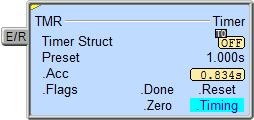
- .Acc
(Accumulator) - a 32-bit signed value that represents the total elapsed
time since the Timer was enabled
- .Done
- is ON any time the Up Timer is enabled and it's accumulator value (.Acc)
is greater than or equal to the Timer Preset value
.Reset - is ON if the input logic is OFF, or if the Timer is being reset by an RSTT instruction
.Zero - is ON any time the Timer's accumulator value (.Acc) is 0
.Timing - is ON if the Timer is enabled
See Also:
TMR - Up Timer
Rung Example:
